Records
Ledger
A structured journal documenting every completed cash movement in sequential chronological order.
Explore transaction matching, statement reconciliation, pending payments, and record discrepancies through independent financial record-keeping examples. BalanceMatch Notebook explains how to investigate differences between account records.
For personal finance learners, household record keepers, bookkeeping students, and Quicken Classic users.
Review your ledger systematically and pinpoint statement differences before month-end closing. Learn the exact routine used by experienced bookkeepers to keep balances aligned.
A printable two-page audit protocol structured for monthly statement review.
Verify the statement opening figure matches the previous closed ledger balance.
Confirm each cleared transaction date against recorded line items without skipping entries.
Identify timing gaps, uncleared drafts, and adjustments before finalizing records.
Clear definitions of essential record-keeping terms so you can verify your monthly paperwork without confusion or guesswork.
A structured journal documenting every completed cash movement in sequential chronological order.
An authorized payment awaiting final institutional clearance that remains provisional on the register.
A transaction that has officially settled and appears posted in the institution statement report.
Any mathematical difference discovered when comparing self-maintained books with verified statement summaries.
The systematic audit proving that internal balance sheets fully align with formal external reports.
A drafted paper payout logged on your register that the recipient has not yet presented for settlement.
The precise closing date dividing current cycle entries from subsequent accounting period items.
The running calculation of net funds reflected in personal notebooks before reconciling timing gaps.
An accidental clerical inversion of two adjacent figures producing an amount divisible by nine.
A matching balance is the result of reviewing records, not guessing the difference. This fictional example shows how one payment recorded in a register but absent from a statement can explain a difference. No real bank accounts, logins, or personal financial data are used.
At month-end closing, the institution statement reported a balance of $1,240, while the personal tracking journal displayed $1,190. The initial calculation produced a discrepancy of exactly $50.
Rather than making an arbitrary balancing adjustment, entries were cross-checked line by line against verified receipts and cleared item lists from the current statement cycle.
The register already includes a $50 utility payment. It has not posted by the statement closing date, so it remains outstanding and must not be entered again.
Subtract the verified $50 outstanding payment from the $1,240 statement balance: $1,240 − $50 = $1,190. This equals the existing register balance. Keep the payment uncleared until it appears on a later statement; do not add a duplicate or force an adjustment.
Master practical techniques to inspect register records, balance statement figures, and resolve accounting discrepancies step by step.

Explore the underlying factors causing variance between internal records and statement figures during monthly audits.

Learn how temporary holds and unposted entries affect daily ledger balance calculations and tracking.

A systematic line-by-line review approach to spot missing entries and timing mismatches with precision.
Detailed technical overviews of digital parsers, data extraction utilities, and ledger balance converters evaluated for record integrity.

An objective review of automated line extraction accuracy when translating paper statement scans into standardized electronic register formats.

Analyzing manual adjustment features, multi-entry pairing controls, and statement register comparison mechanisms in modern interfaces.
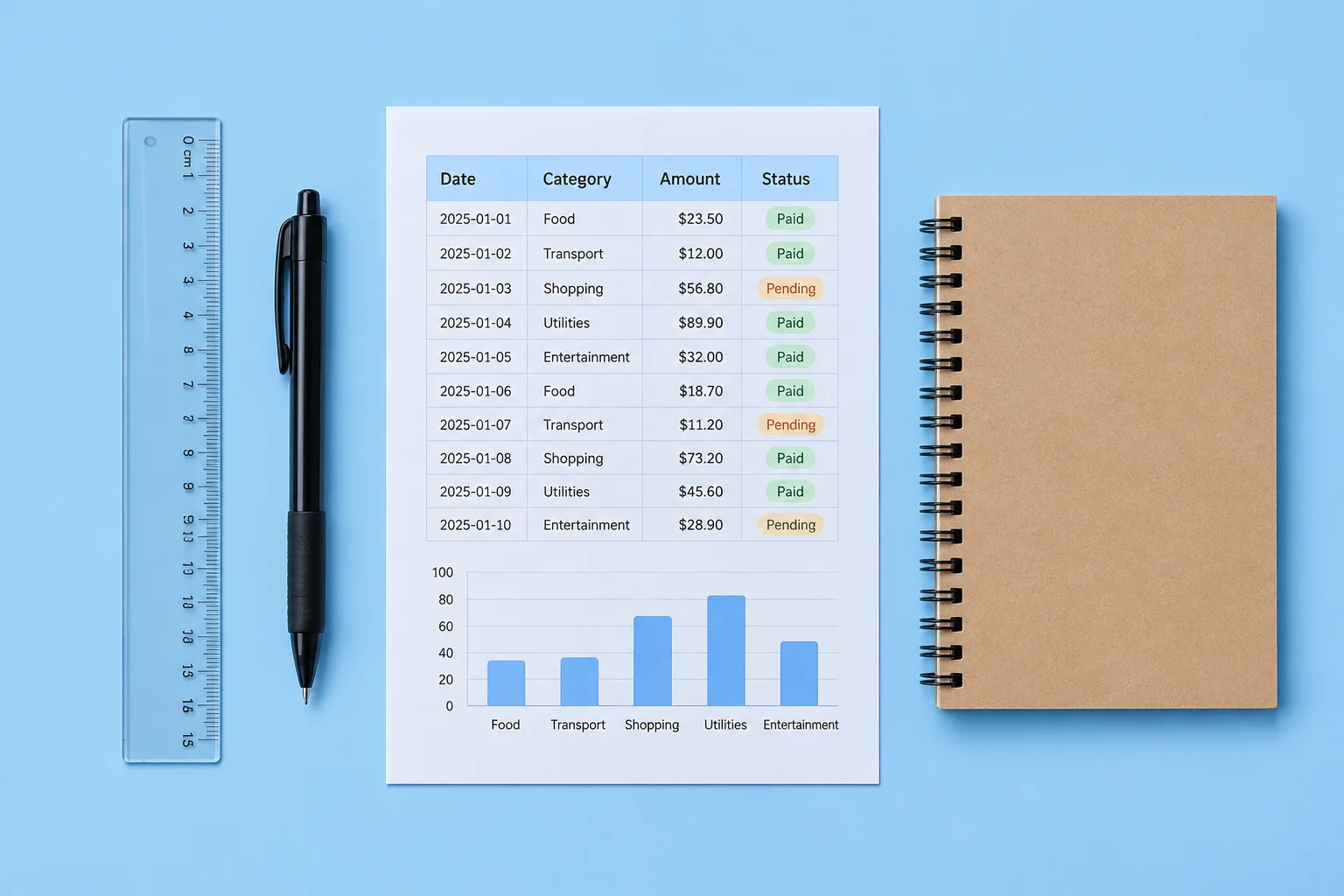
Assessing table detection algorithms that convert scanned ledger sheets and receipt copies into tabular spreadsheets for audit comparison.